
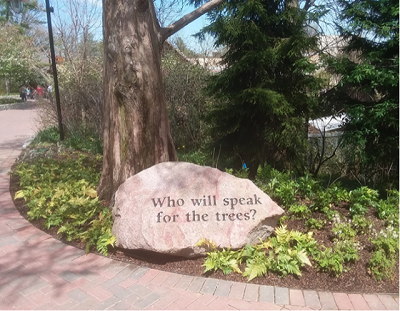
Who will speak for the trees? – Deb Zureick
Come see the new addition to the Garden!
As many of you know this tree has endured major work around it three times. Each time care was taken to protect the root system and keep this stellar Dawn Redwood (Metasequoia glyptostroboides) healthy and thriving.
The Garden has a great diverse collection of trees. Some of our great old trees, like the giant elm in Safari Camp and the Chinquapin Oak (Quercus muehlenbergii) between Veldt and Wolf Woods, are well over 100 years old. These and many other magnificent trees were passed to us from generations ago. What a gift! The preservation and care of our trees give our Garden the sense of age and beauty that this Zoo deserves.
As we move forward we continue to plant trees for the future. When the old red oak in Centroid came down it was replaced by five new oak trees in that area. We planted different oak species for diversity and oaks for the sheer volume of benefits they provide to wildlife and people. In 2017 we planted over 325 trees. It is our goal to leave a legacy of trees for many, many generations to come.
Reminds me of this saying: “A man only begins to grasp the true meaning of life when he plants a tree under whose shade he knows he will never sit.”
History of the Dawn Redwood – Scott Beuerlein
In 1940, a Japanese paleobotanist found fossil evidence in China of a tree very similar to bald cypress. In 1941, he described it and named it Metasequoia glyptostroboides.
That same year, a Chinese forester was travelling in eastern Sichuan province and noticed three intriguing trees. He asked a district school principal to collect samples and send them to him. This was done but the tree was never identified.
In 1944, the school principal, acting on his own, asked China’s Forest Research Center to investigate.
In 1946, the Forest Research Center sent a graduate student to go collect more samples. He arrived while the tree was dormant but collected some cones and branchlets. He then was sent back a second time to collect and preserve viable leaves. Each trip entailed two days travel by steamship followed by a 72-mile hike through bandit country. Apparently, this sort of treatment of graduate students is time-honored and universal.
All the necessary materials finally collected, the Forest Research Center now knew for certain they had a new genus. Specimens and information were sent to a Dr. Hu at the Fan Memorial Institute in Beijing. Dr. Hu, having read the Japanese paleobotanist’s published findings five years before, realized he was looking at the same plant. He then published the discovery.
Meanwhile, Dr. Cheng at the Forest Research Center, a Harvard graduate, sent herbarium material to the Arnold Arboretum in Boston, which immediately funded a seed-collecting trip for 1947.
That seed expedition located more than 1000 trees in a 25-mile long valley of the Yangtze River, but only two pounds of seed were collected. This seed was dispersed by the Arnold Arboretum to arboretums throughout the United States, including the Rowe Arboretum in Indian Hill, and throughout the world. From this collection, plants entered the horticultural trade.
Nothing more was known about dawn redwood in the wild throughout the cold war. Once relations between China and the West resumed, it was discovered that the tree was now extirpated from that valley. I’ve heard conflicting things about it being found in small numbers in another nearby valley. Fortunately, it is an easy tree to grow and can now be found in most nurseries.