
Good morning,
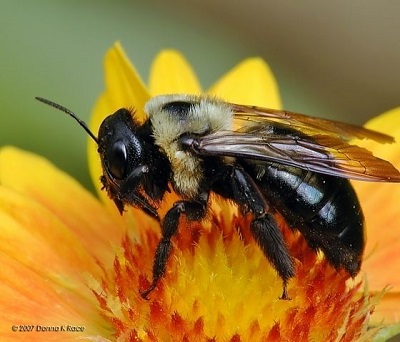
It’s spring at the Cincinnati Zoo & Botanical Garden, time for my annual Carpenter Bee email. Carpenter Bees (Xylacopa viginica) are the large, yellow and black flying insects frequently encountered on zoo grounds at this time of year. Though often mistaken for Bumblebees they can be most easily differentiated from them by their hairless abdomens; Bumblebees have fuzzy abdomens. Carpenter Bees were so named because the females excavate nest tunnels in wood. They only nest in the wood, they do not eat it. And while nesting bees sometimes damage wooden structures the damage associated with them can sometimes be caused by woodpeckers working to excavate the bees themselves for food.
Carpenters bees overwinter as adults and are among the first insects observed in spring. The Carpenter Bees encountered by CZBG guests and staff are generally males. Male Carpenter bees can be easily differentiated from females by the white or gold patch between their eyes. Each male stakes out a territory in the vicinity of a nesting female, awaiting the opportunity to breed with her. Any male Carpenter Bees entering the territory will be chased away and anything else entering the territory will be investigated. It’s these investigative flights that bring them into close proximity with zoo guests and staff. Carpenter Bees are large and fast flying so it’s easy to see why people mistake their curiosity for aggression even though they’re essentially harmless. Male Carpenter Bees, like all male bees or wasps, cannot sting; the stinger is a modified ovipositor (egg laying organ). Female Carpenter Bees are capable of stinging but rarely do. They spend most of their time visiting flowers or in their underground nest tunnels.
In a few weeks the Carpenter Bees we’re seeing will be gone but in the tunnels they’ve created, their offspring will live on. In mid-late summer young Carpenter Bees will emerge to feed on nectar in preparation for overwintering. They’ll generally overwinter in the same tunnels their ancestors survived previous winters in. Carpenter Bees on CZBG grounds are going about their lives the way they have for countless millennia, they’re just doing it at the zoo instead of in an eastern forest.
Most of our guests don’t understand Carpenter Bees and people almost always fear what they don’t understand. The reality is Carpenter Bees pose almost no danger to people. In my experience, people are more likely to be injured trying to swat or flee Carpenter Bees than by the bees themselves. If you see guests having a negative interaction with Carpenter Bees please take a minute to educate them. There’s really nothing to fear.
Winton Ray
Curator of Invertebrates, Aquatic Animals & Birds